
Before I openly defined my freelance UX/UI project as a values-based business, whenever I talked about it, the reaction was always the same:
“That sounds wonderful, but we all have to earn a living.”
Now that I’m fully committed, people don’t say much out loud — but I can almost hear their thoughts:
Really?
This sounds cool!
But… is it profitable? It should be if she’s doing it.
Then why am I not doing it? Am I doing something wrong?
Oof, this is too complicated. Just smile and nod.
And honestly? I get it.
It can feel scary (what if no one hires you?), hard (hello, niche-business headaches), and pretty lonely (especially before you find your people).
Plus, let’s face it—the stereotype doesn’t help. Purpose-driven work is often painted as serious, joyless, and a little… beige.
But that isn’t my experience.
Don’t get me wrong—it isn’t easy. But other people’s journeys made it feel possible and worth it (and it is!). And now, I’d like to do the same for someone else.
Join me through all the released episodes about of how I went from a conventional UX/UI designer to a responsible one.
The One Before I Knew
Many people involved in any kind of activism come from a context that naturally has been leading them to the place where they currently are.
That wasn’t my case at all.
Before I even knew what sustainability or social responsibility was I was just a regular carefree teenager. In my family, not only there was no debate about current affairs, but any ideological expression or advocacy was frowned upon.
BUT, I have been my whole life the Tell Me Why kind of girl. The world felt far too vast and diverse for things to be “just like that”.
So, I kept asking questions.
About everything.
The One When I Started to Knew
Over the years, I met many people who rejected my curiosity—or even tried to suppress it—and many others who nurtured it.
I’m incredibly grateful to the latter because they helped me slowly figure out my place in the world. They taught me that my actions ripple out into the world, and that it comes with a certain kind of power and responsibility.
There was one specific moment when the seed of sustainability began to grow in my mind. It happened in 2019, during a ten-minute talk at a local WordCamp.
A guy from Valladolid (Spain) shared a simple yet powerful idea: the Internet consumes energy. And that energy has to be produced some how. So, the Internet is physical. And you (my) use of it has real-world consequences.
Quite a revelation.
The One Where It Started to Make Sense
This seed remained hidden beneath the surface for a while, but occupying some space in my mind.
I didn’t suddenly change the way I worked, but I started digging for information about it. I also began following people who were talking about these topics. And not just environmental sustainability, but digital responsibility in a broader sense.
One great example was Nahuai Badiola’s newsletter.
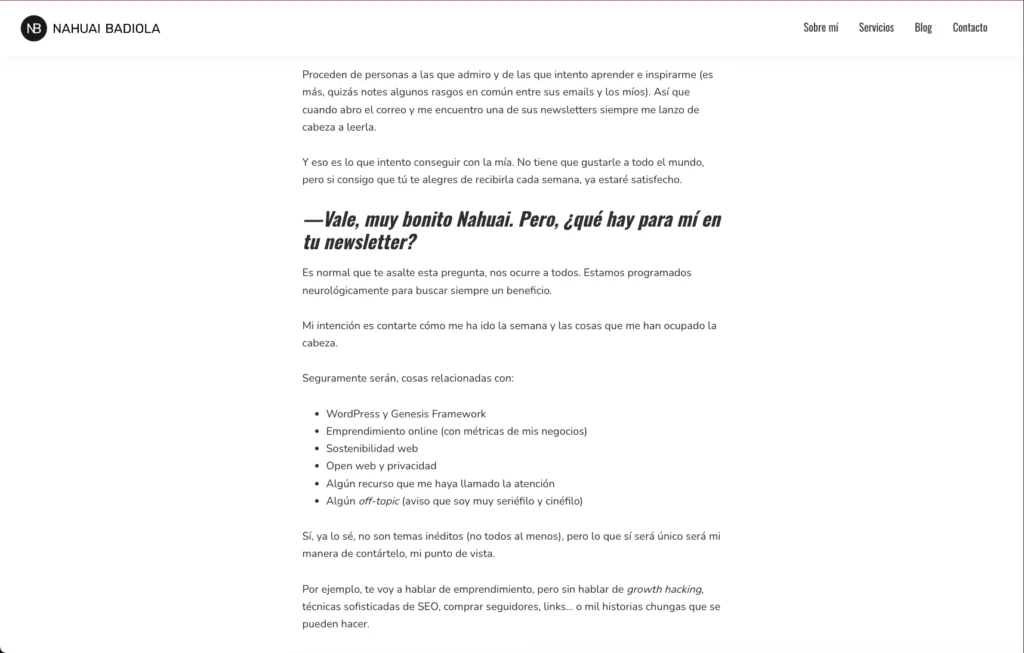
Besides sharing WordPress news, he also covered things like privacy, security, and environmental sustainability. Tbh, WordPress is cool but I basically stuck around for the responsible content.
Finding this kind of content made me feel that this topic mattered enough to be worth my time and energy. So I continued investigating.
The One Where It Got Serious
My work as a UX/UI designer kept moving forward—and so did my curiosity about digital responsibility.
One random day, the ultimate book recommendation popped up on Twitter—yeah, there was a time when you could get good stuff out of that swamp—:
Mike Monteiro’s Ruined by Design.
I’m actually working on a full review of it, but here’s the gist: tech workers are building the world we live in, and we’re not doing a great job.
Monteiro talks about how technology shapes our lives and the huge responsibility that comes with designing it—whether you’re a designer or any other professional in the field.
In 2025, this might sound obvious after everything that’s happened. But back then, it wasn’t obvious to me at all.
I hadn’t fully realized that my decisions as a designer truly mattered.
They do.
So it was time to take action.
The One with all that people
What could I do in my own? Honestly… not much.
Because here’s the thing, kids: doing good takes a village.
So, I decided to go out and find people who were crazy enough to believe we could do better.
The first step was the easiest one: I reached out to Nahuai Badiola. Remember him? The guy with the WordPress newsletter I kept reading for everything except WordPress.
We both attended WordCamp Europe 2022. Nahuai encouraged me to publicly ask a question about sustainability in the WordPress community. Summing up: a year later, an official WordPress Sustainability Team was born.
…And then, it got shut down. But hey, that’s another story.
What matters is that I suddenly found myself surrounded by incredible, passionate people. People who genuinely care and are willing to put in the work to make things better.
Turns out, there was a village all along. And now, it was my turn to step up and become a full-fledged citizen.
The One Where I Chose My Own Way
Fueled by the support of all those amazing people—and by the work we were doing in the Sustainability Team—I decided it was time to move from being a regular UX/UI designer to a specialized one.
The obvious approach was:
“Okay, I’m a UX/UI designer, but I’ll design with sustainability, accessibility, privacy, ethics—in short, responsible design—in mind.”
Tbh, there aren’t that many designers out there doing this—shame on us. But I didn’t just want to offer services or skills—I wanted to offer a solution.
One day, the CEO of an agency that specialized in digital project management for non-profits reached out to me. He told me about a challenge they kept facing: they wanted to keep away the the idea that technology has to be serious and boring in order to be responsible. They wanted a designer who could bring an ethical approach without sacrificing the user experience. We didn’t end up working together, but his words stuck with me.
Since then, this idea popped up everywhere. Many developers and other non-designers colleagues kept bringing up the same complaint: responsible websites often lacked sex appeal.
They had a point. And I had the design skills to do something about it.
The One With All the Doubts
Things seemed to be going my way—and, in many ways, they were. But taking this step also meant facing the dark side of managing a purpose-driven business.
The contradictory portfolio
I want to offer responsible design for responsible clients, but I come from a generalist background, working with people who don’t necessarily care about these issues. That means that while I’m slowly building a portfolio that reflects my values, most of the work I have to show right now doesn’t align with my philosophy as much as I’d like. It’s a real hellish loop.
Still working on “not-so-responsible” projects
Bills have to be paid, and purpose-driven clients don’t grow on trees. It takes time to make a name for yourself and build a community around your brand. But in the meantime, the supermarket won’t let you pay with good intentions, so you take on projects that don’t fully reflect your ideals. You see where I’m going.
Pushback from regular clients or colleagues
Many don’t share—or even understand—this approach. Sometimes I end up justifying my work as if I need to apologize for it. Look, I’m the one trying to make the world a better place through design here!
Scrutiny from “responsible” clients or colleagues
On the flip side, you get extra attention from those who do care about responsibility: “Are you really as responsible as you say? Because I found an accessibility issue in that design. And by the way, you didn’t use WebP images there either.”
Impostor syndrome loves to thrive in this kind of environment.
To be fair, most of this pressure comes from my own mind. People have actually been incredibly kind and supportive about my new approach as a designer. Trolls are definitely the minority.
The One That Kept Me Going
With all that on my back, you can imagine that staying on track is difficult. This is one of the millions of reasons why doing goos takes a village. You need to receive comfort from others some times to keep going.
I don’t want to go on at length enumerating all the people and moments that have given me encouragement to continue. I am going to tell you two that can be useful for you too.
Not the end of the world
Does Hannah Ritchie know how incredibly comforting her book is?
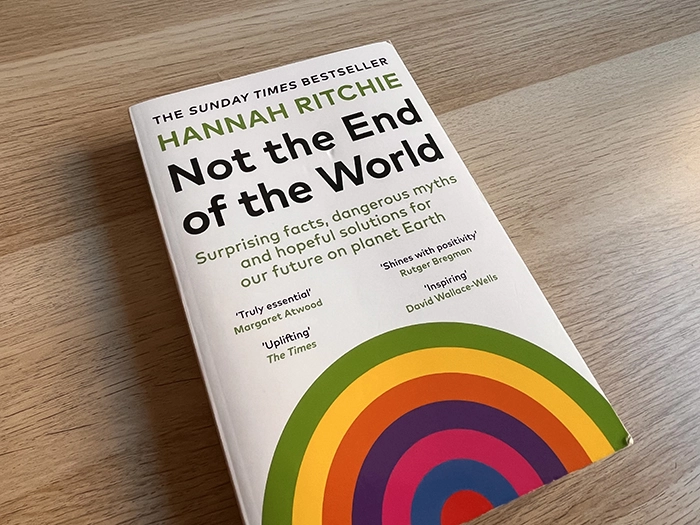
She takes hard data and uses it to show us something we don’t hear often enough: things are actually getting better. Her message is basically, “We need to keep pushing and fighting—because pushing and fighting actually work. Look at the data, you poor, tired soul!”
And she does it all in a super clear, no-nonsense way. No doomsday drama, no naive optimism. Just facts—and a roadmap of where we still need to go.
One thing I especially love is her take on the margin for improvement, which helps put certain comparisons into perspective. Take combustion cars vs. electric cars, for example. Combustion cars have been optimized for decades; there’s very little room left to make them significantly better. Electric cars, on the other hand, are still new. There’s so much room for improvement. Comparing them directly, as if they were on the same level, just isn’t fair.
So don’t let the doomers fool you: every step forward matters.
We just have to keep pushing—and keep fighting.
Find your village
I know I repeat myself, but it’s true—and I finally have proof.
Until September 2025, I’ve been part of an advisory group exploring how to create grid-aware websites. The project itself is fascinating, but honestly, the best part has been the people.
I still remember the first meeting I was so nervous, surrounded by all these experienced folks deeply involved in digital sustainability, while I was just starting out. I kept thinking, “What could I possibly bring to the table?”
A few months later, during a more relaxed call, we all admitted something: these calls were… kind of therapeutic.
That conversation completely shifted my perspective. It made me realize that digital sustainability is still such a young field. Even the most experienced people are figuring things out as they go. We were all there not to show off expertise, but to pool our knowledge, share our different points of view, and push together in the same direction.
There was no judgment, no scrutiny, no “silly questions”.
Just a safe, supportive space—and the relief of knowing you’re not alone in this slightly crazy mission to make the world a little better from our tiny corner of it.
The One With the Lessons I’m Taking With Me
I have learned a lot of things during my journey into sustainability and responsibility. But there are three that I feel as the core of it:
- I didn’t make myself responsible; community made me responsible. Others showing up for responsibility helped me to become responsible. Never underestimate the power of showing up, you never know who you might inspire or influence.
- Responsibility is not a destination — it’s a journey. And there are as many paths as people. Just keep building and evolving yours.
- Responsibility creates identity. As each journey is unique for each of use, it’s obvious that taking responsiblity shapes and shows our identities. And having a different and a solid identity is great in business.
The One Where You Join the Story
As you can see, there’s no specific resources or context you need to start you own journey toward digital responsibility. There is no specific destination either—it’s all about the journey. Just start exploring it wherever you find it easiest, most logical, or most useful.
I hope this post has served you as a seed, as a point where things started to make sense or get serious, or as the push that keep you going.
Or maybe you’ve helped others to shape their own journey.
In any case, I would love to hear your stories: knowing that there are people out there walking this path is always helpful and inspiring. You can share them here in the comments or directly send me a message.
Take care and keep going.
Leave a Reply